Course Enquiry (discount)
I would like to book this course with a special discount of 3% (condition: you must book before November 23, 2022).
"*" indicates required fields


If you work in HR, IT, project management, or leadership, you have likely encountered the term “change management.” Perhaps it was during a system rollout, a restructuring, or a conversation about why a major initiative did not achieve the planned outcomes. But what does change management mean? And why do people use so many different terms to describe it?
Individual change management and organizational change management are related yet different approaches to change. Depending on how advanced your organization is in managing change, a third approach, called “enterprise change management,” may also be relevant to your work.
These three terms describe three distinct levels of practice, each with a different focus and purpose. Knowing the differences helps you understand how managing change works, where it tends to break down, and which approaches to apply to be successful. Here’s an overview.
Organizations across Africa are managing more change, more often, and at a faster pace. Today, new technologies, shifting workforce expectations, evolving funding environments, and rapid growth often affect an organization all at once.
Change management helps your organization, employees, and stakeholders adapt to important changes like these and others, making them more successful and less disruptive. When done well, change management determines whether your investment delivers on its promises.
However, every organization is in a different place, and every change requires a different level of attention. Various approaches are designed for use at some levels and not others. Before choosing an approach, remember that it should match the level at which your change is taking place: individual, organizational, or enterprise. Here’s an overview.
Every change, no matter how large, is experienced by one person at a time. Whether a new system goes live, a process is redesigned, or a strategy shifts, individuals must let go of familiar ways and build new habits. That is harder than it sounds.
Individual change management is the structured support that helps a single person move from where they are today to where the change requires them to be.
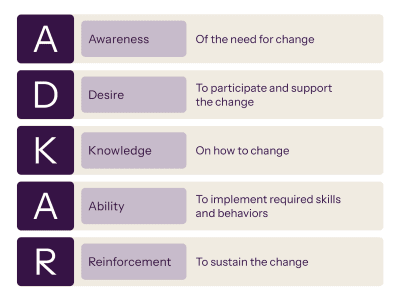
The most widely used framework for this is the Prosci ADKAR® Model. ADKAR describes five outcomes each person needs during change: Awareness of why the change is needed, Desire to support it, Knowledge of how to change, Ability to perform in the new way, and Reinforcement to sustain it.
The model is sequential but not always linear. When helping a person through a change, they generally need awareness before they can build desire, and knowledge before ability. However, someone can lose desire after gaining it, or find their ability lapses without reinforcement. Skilled change practitioners watch for these patterns and respond to them.
If you are a professional in HR, IT, management, or project delivery, you are already doing individual change management, even if you have not called it that. Every conversation where you help someone understand why things are changing, or work through their hesitation, is this level of practice in action.
Prosci ADKAR Model
ADKAR is a registered trademark of Prosci. Inc.
Read more: Improve Your ADKAR Skills for Better Organizational Change
When a change affects hundreds or thousands of people at once, you cannot manage it person by person. You need a plan that coordinates communications, training, leadership engagement, and support across the whole organization, all in service of helping individuals make the transition.
This is organizational change management (OCM): a structured approach to managing the people affected by a change, enabling successful outcomes.
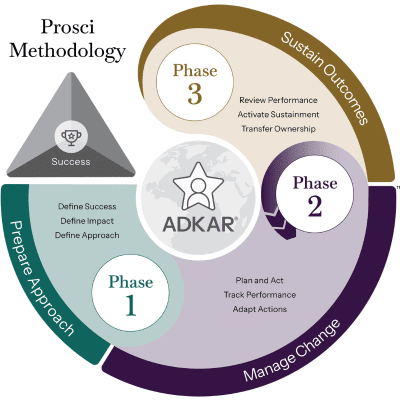
There are several organizational change management approaches available. Organizations that apply the Prosci Methodology and 3-Phase Process equip groups of people for change. Change managers apply a structured process, building readiness beforehand. Then they help people adopt the needed attitudes and behaviors during the transition. Finally, after the change goes live, they work to sustain the results.
OCM is the bridge between what the project team delivers and what the end users adopt. Project management handles the technical solution, like a new ERP system, while organizational change management supports the human journey.
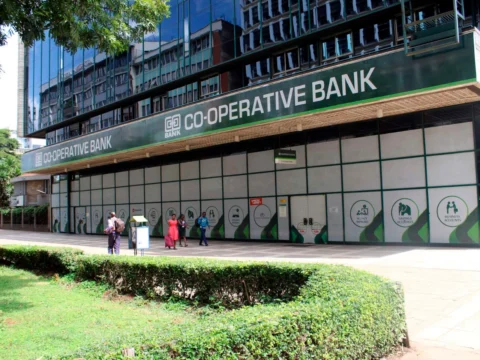
We have seen this play out across East Africa. When Naivas Supermarkets rolled out a new ERP system across 110 stores and more than 12,000 employees, structured OCM was what turned a high-risk implementation into a 90% adoption success. When Co-operative Bank of Kenya replaced its core banking system, dedicated change management was what ensured employees moved from knowledge to demonstrated ability—and stayed there.
What if your organization did not have to rebuild its change capability for every new initiative? What if your leaders already knew how to sponsor change, your managers already knew how to support their teams through it, and a common language for change was simply part of how your organization operates?
That is enterprise change management. It’s not a project, but an organizational competency. It’s “change capability” woven into strategy, structure, and culture, so that every transformation draws on what the organizational already built rather than starting from scratch.
An organization with genuine enterprise change capability demonstrates several characteristics:
CRDB Bank, Tanzania’s largest commercial bank, is a compelling example of this. After years of change initiatives that underdelivered, the bank invested in building enterprise-level capability—common frameworks, certified practitioners, and change embedded in strategic planning. The result was not just better projects. It was an organization that became, in their own words, genuinely good at change.
Enterprise change capability takes time to build. The Enterprise Change Management Boot Camp is one place to begin that journey.
These three levels are not alternatives. They work in concert:
When all three are aligned, the difference is visible. Employees understand and embrace what is being asked of them. Leaders are equipped to guide their teams, not just announce the change. And the organization grows stronger with each transformation, rather than returning to zero.
Your entry point depends on your role, but all roads lead to the same destination: lasting change.
If you’re exploring change management as a career or organizational capability, you will find it a rigorous, rewarding pursuit. Discover our training programs.
Organizational change management offers advantages for organizations at every stage of change management maturity. Whether you are supporting one person through a difficult transition, leading an organization-wide transformation, or building long-term change capability in your institution, there is a level of practice that fits where you are.








Get in touch!