
Course Enquiry (discount)
I would like to book this course with a special discount of 3% (condition: you must book before November 23, 2022).
"*" indicates required fields


Most change management professionals are familiar with the ADKAR® Model. Many have been trained in it, used it in projects, or relied on it to help people adopt organizational changes. And yet, across East African organizations, change initiatives that appear well designed on paper still struggle to gain adoption. Systems go live, structures shift, strategies are approved, and then people return to familiar ways of working.
When change practitioners say they don’t find ADKAR useful, it’s often because application is missing something. If you look closely, what varies is depth, discipline, and understanding.
Change management is complicated by high-growth environments, project complexity, cultural nuances, and constant pressure to deliver results. These conditions are ubiquitous across Africa today. But if you learn to apply ADKAR with greater intention, it will make a difference in your outcomes, and might even become your favorite change management tool.
If you know ADKAR, you know organizational change succeeds only when individuals change.
This is widely accepted in principle—but surprisingly overlooked in practice. Under pressure to meet timelines and deliverables, organizations tend to focus too much on technical solutions without giving people the support they need to truly adopt and use them.
The ADKAR Model continues to offer a structured way to think clearly about how people adapt to change. The ADKAR Model:
The ADKAR Model is also sequential, designed to help people progress through its elements one by one.
But did you know that the key steps in the ADKAR Model are not actually steps at all? This is because progressing through ADKAR is not always linear. People often move backward (e.g., from Knowledge back to Desire) when they encounter a new obstacle and need to revisit an element before moving forward again.
Learn how Prosci Change Management Certification sets you up for 7x success.
When organizational changes don’t deliver as expected, evaluating how you applied the elements will yield insights about adoption (i.e., the people side of the change). Each element of the ADKAR Model aligns with key aspects of organizational change and how people adopt it.
The Prosci ADKAR Model
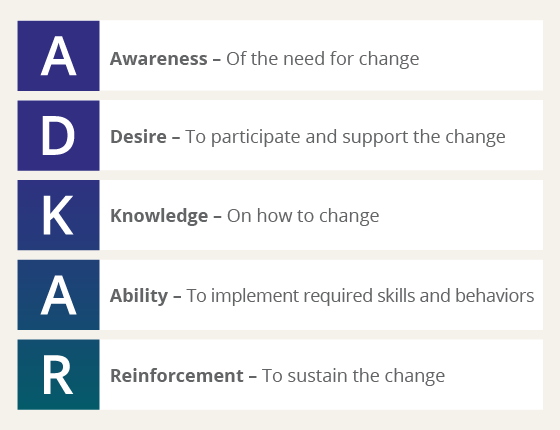
ADKAR and the ADKAR Model are registered trademarks of Prosci, Inc.
ADKAR’s first element, Awareness, is often taken for granted. People assume they have created the needed awareness after communicating about the change in announcements, email messages, and on the company intranet. However, building awareness is more than communication. Awareness is about understanding the need for change, not simply receiving information.
In many East African organizations, low awareness shows up as polite agreement without real commitment. People attend meetings, acknowledge the message, and continue working as before.
Strong awareness answers a few essential questions for people:
Change practitioners who build effective awareness work closely with leaders to ensure messages are credible, aligned, and repeated over time. They recognize that employees, middle managers, and senior leaders often require different explanations, even when the change they’re experiencing is the same.
When awareness is low, employee resistance tends to grow.
Desire is shaped by trust, perceived impact, and personal risk—not enthusiasm. Desire is about willingly accepting change and agreeing to participate in it.
In hierarchical environments, resistance to change is not always vocal. More often, it appears as slow adoption, selective compliance, or discreet workarounds. Treating these behaviors as defiance misses a critical opportunity to listen and understand.
Experienced practitioners listen carefully to uncover what sits beneath resistance. For example, employees can have realistic concerns about loss of status, increased scrutiny, or past experiences with change that did not deliver promised benefits.
This is why building desire takes more than explaining the advantages of changing.
Strong desire-building requires:
Building desire in this way helps ensure the change is well-received and accepted by employees.
Although ADKAR is an effective strategy for overcoming resistance, desire cannot be imposed on people. It develops when people believe the change is necessary, fair, and supported.
Training is a familiar and needed activity during change, but it can be poorly timed or too generic.
When knowledge-building begins before awareness and desire are in place, people attend sessions before they have developed a learning mindset. Because employees aren’t ready to learn, the training delivers information, but little changes in practice.
Effective knowledge requires:
In regional or multinational initiatives, knowledge building also requires adapting training and materials to reflect local realities.
Knowledge is about people learning how to do their job differently. It answers practical questions for every individual: How does my work change? And what does good performance look like?
Ability is where change shows up in day-to-day behavior. It is also where many initiatives lose momentum.
Knowing what to do is not the same as being able to do it consistently, especially under pressure. Ability develops through practice, feedback, and support over time.
Strong ability-building requires:
Change management practitioners should treat ability as a transition period rather than a single milestone. This means working with leaders to remove obstacles and support people as they build confidence in the new behaviors.
In fast-changing environments, reinforcement is often overshadowed by new priorities. Yet without it, even well-adopted changes slowly erode.
Reinforcement is less about messaging and more about alignment. People pay close attention to what leaders reward, what they tolerate, and how decisions are made under pressure.
Effective reinforcement requires:
Reinforcement sustains adoption of the change well beyond the go-live date. Without reinforcement, people revert to familiar habits that feel safer and more efficient.

The beauty of the ADKAR Model is its simplicity. You can start applying it right away once you understand how each element works during change. But don’t stop there. Proficiency and better results come from applying the model to different changes under varying circumstances. The ADKAR Model is a powerful tool for organizational change of all kinds, from digital transformation to organizational restructuring, and is particularly helpful for complex changes where people need support.
Culture change often feels abstract and slow, which is just one reason why it is so challenging. The ADKAR Model helps make it more tangible.
Shifts in culture occur when individuals understand why old norms no longer serve the organization, choose to adopt new behaviors, learn what those behaviors look like in practice, and are supported to sustain them over time.
In African organizations with strong histories, identities, and relational dynamics, culture change requires care. Using ADKAR is a structured way to support that journey without oversimplifying it or rushing it.
Complex technology changes like ERP implementations affect processes, roles, decision rights, and accountability, and more, often all at once. Technically, many ERP projects succeed. Systems go live and data migrates. The real challenge is adoption.
Awareness in ERP change goes beyond explaining the system. It requires clarity on why existing ways of working can no longer support the organization’s direction. People are often attached to familiar tools and workarounds, even when they are inefficient.
Desire is where ERP initiatives frequently stall. Standardization and transparency can feel threatening. Concerns about loss of autonomy, exposure of errors, or reduced confidence are common and often unspoken.
Knowledge must be role-based and sequenced. Treating all users the same can overwhelm some and underprepare others. People need to understand not just how to use the system, but how decisions, approvals, and responsibilities will shift.
Ability becomes critical after go-live. Without accessible support, practice in real scenarios, and manager reinforcement, users revert to parallel systems and workarounds.
Reinforcement ultimately determines whether the ERP becomes the system of record or simply another tool. Leadership behavior, performance expectations, and decision-making practices all signal whether the change is truly embedded.
ERP systems expose organizational habits. The ADKAR Model helps practitioners address those habits deliberately rather than hoping they resolve themselves over time.
Change practitioners who rely on ADKAR to consistently deliver successful change tend to work differently. They:
Successful change practitioners know ADKAR is not just a model. ADKAR shapes how they think about the people side of change.
Applying ADKAR more effectively can come down to a few disciplined practices.
ADKAR is widely known around the world and across East Africa simply because it works. What differentiates outcomes is not the model itself, but how thoughtfully it is applied. In complex, fast-evolving environments, superficial application is not enough. Proficiency comes from disciplined use, honest diagnosis, and sustained leadership engagement. That is often where meaningful change begins.










Get in touch!