
Course Enquiry (discount)
I would like to book this course with a special discount of 3% (condition: you must book before November 23, 2022).
"*" indicates required fields


ERP (Enterprise Resources Planning) software or systems can be described as a single complete system which aims at integrating all business processes and the sub processes in a single system. This system is integrated in an organization so that the business goals are managed and organized effectively and efficiently. Organizations implement the ERP system to manage their day-to-day business activities such as accounting, procurement, project management, risk management and compliance, and supply chain operations in a more effective way. The organization’s needs determine which of the various ERP modules will be implemented.
Organisations move away from systems that are not integrated (also referred to as standalone systems) to ERP systems to obtain some of the following benefits:
Also Read: How To Manage Change for An Organisation Restructure
Prosci, which is the world leader in Change Management, defines change management as the application of structured processes and set of tools for leading the people side of change to achieve a desired outcome. In short, Change Management focuses on the people side of organisational changes. The more important the people side of a change becomes to get to the ROI or realise the business case; the bigger the role Change Management must play in taking organisations through the change.
When organisations implement ERP systems, the following often form part of the implementation of the ERP system:
The above clearly indicates that with the implementation of an ERP system, staff in the organisation are affected to varying degrees. As people begin to react to the change, they may start to feel concern, anger, resentment, or fear. They may resist the change actively or passively. They may feel the need to express their feelings and concerns and vent their anger. This is where Change Management plays a role.
Also Read: 5 Tips To Managing Resistance To Change
The diagrams below from Prosci indicate the “link” between the Technical Side and the People Side of a change.
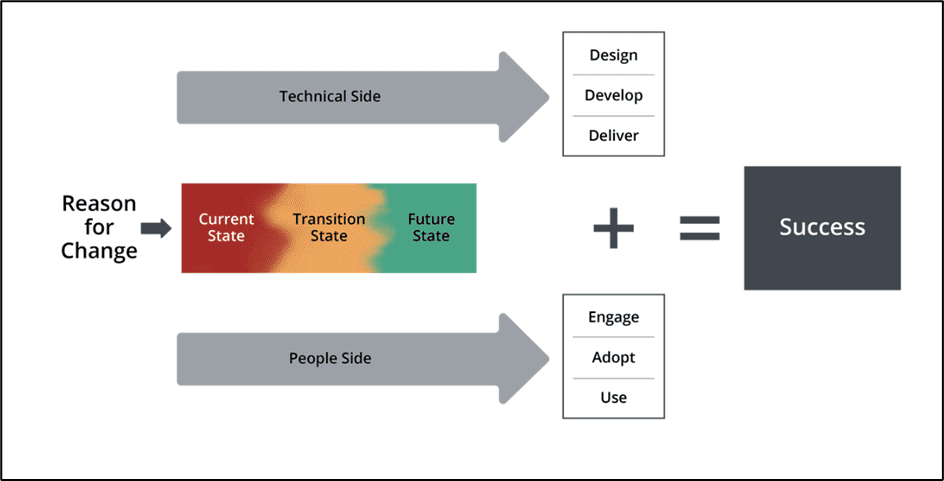
Copyright: Prosci
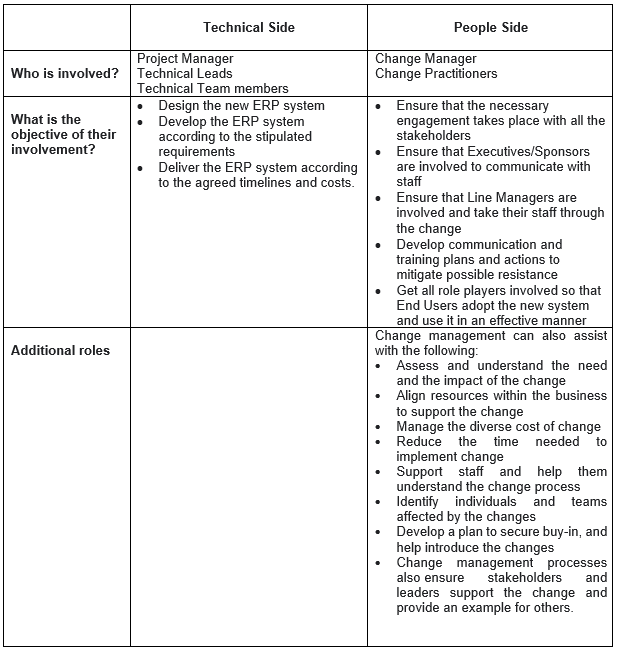
In the table below the close relationship between The Technical Side and the People Side will be described in more detail.
Also Read: Change Champions are Key to Successful Change Outcome
Change Management (the People Side of the ERP implementation) works closely with Project Management (the Technical Side of the ERP Implementation). The above indicates that when organisations implement ERP systems, the management of the people side is very important. Therefore Change Management is needed in any ERP implementation as well as other organisational changes.
Written By Willie Jooste

The disciplines of change management and project management cross paths throughout the execution of a project or initiative. Each brings necessary and critical structure for effectively implementing change and realizing results.
Change management and project management, in a combined effort, present a unified value proposition for achieving successful change by providing a foundation for the tactical integration at the people, process and tool dimensions.
Click here to listen to a webinar on the importance of these complementary disciplines that share a common objective – change success!












Get in touch!