
Course Enquiry (discount)
I would like to book this course with a special discount of 3% (condition: you must book before November 23, 2022).
"*" indicates required fields

Is your organisation embarking on culture change? Or perhaps you are already down that road and are looking to make it a success?
Well, there is no perfect formula to change the culture in an organisation; there are however some critical factors that should be considered in making it a success.
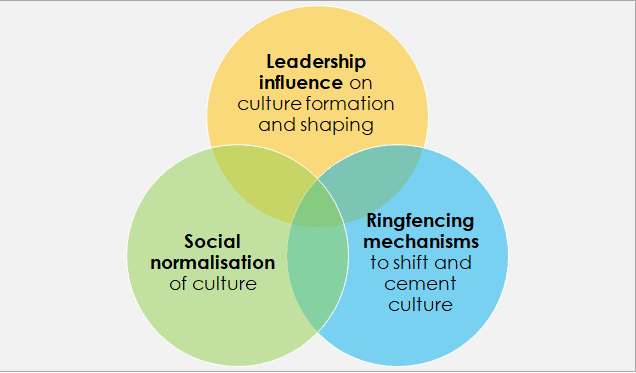
Three pillars of successful culture change as informed by extensive research and experience are:
In other words, whichever approach an organisation considers in changing the culture, its potential for success can well be evaluated against these three pillars.
We discuss each as below:
Leadership influence refers to the critical role leaders play in influencing and shaping the type of culture the organisation should adapt.
Examples of culture change leadership strategies include:
Culture change success probability increases when led from the top thus must deliberately include planned activities for the leaders towards the desired change. Leading culture change cannot be taken for granted if a culture change effort must succeed.
Social normalisation refers to how the rest of the organisation, individuals and teams, consciously travel through the culture change journey, characterised by being aware of the need for culture change; the type of culture change required; embracing, adopting and applying the new culture; and normalising the new culture in their day-to-day work and engagements. Examples of social normalisation strategies include:
Most culture change programmes tend to take this form, where there is a great emphasis on behaviour change and normalisation of new ways of working through culture change emphasis engagements. While this is known to be an effective strategy, it cannot work in isolation from the other two pillars.
Ringfencing mechanisms refer to strategies or interventions which ensure culture change is enabled and embedded in the organisation for long-term sustainability.
These include:
An effective culture change approach needs to intentionally and actively incorporate strategies and interventions in all three pillars to guarantee greater chances of success.
Author: Dr. Antony Mburu
Organisation Development and Change Management Consultant
MORE FROM CEDAR AFRICA GROUP
Culture Transformation and The Role Of Leaders
Culture: The Invisible Enabler of Change
Building an Agile Culture Through Digital Transformation in Africa












Get in touch!