Course Enquiry (discount)
I would like to book this course with a special discount of 3% (condition: you must book before November 23, 2022).
"*" indicates required fields


“Help, my project goes live next week, and we are seeing all sorts of issues and resistance. Is it too late to apply change management?”
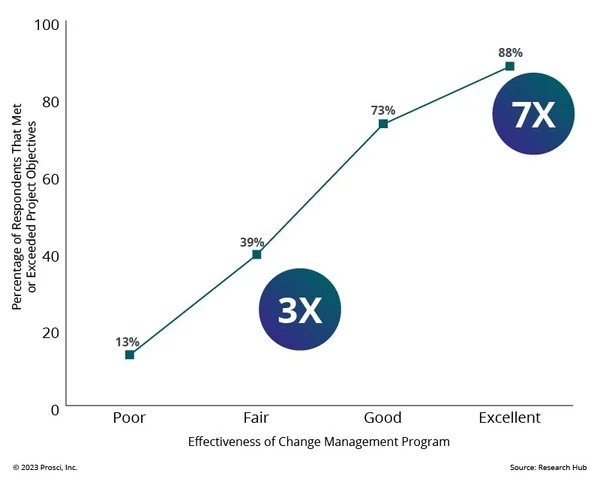
Whilst that might seem like an extreme, though I can assure you not an entirely uncommon, discussion, that is probably not the best time to point to the research that shows that you have an increased probability of exceeding or meeting your project objectives if you start change management much earlier, ideally at the project initiation.
The challenge is that whilst project management is a mature discipline, change management is catching up, and it’s catching up fast, as there is a growing realisation and understanding that delivering the technical side of the project is literally only half the story. The slide below shows that with excellent Change Management, you are SEVEN times more likely to achieve or exceed the expected and desired outcomes. But the great news of this really strong correlation is that even when you have less time and less resource and so can only do a ‘fair’ amount of change management, you are still THREE times more likely to achieve or exceed the expected project objectives.
Even with its left late, don’t be resigned to missing out on applying change management and just crossing our fingers, hoping for the best! No, it is never too late to be able to add value and mitigate some of the issues and guide the project to a more successful outcome.
Prosci have a very powerful model called ADKAR that describes the change that every individual goes through during the project. This model helps determine where they are in the model and then guides you with some corrective actions. In the same way, we see a connection to the individual change to the full organisational change by their demonstrated Ability (note that ability is not simply knowing what to do, but it’s doing it proficiently.)
Depending on the actual time available, you will spend more or less time, but you need to cover all of these key steps, which also help to reinforce any change implemented:
I would always encourage you to start your Change Management as early as you can, it’s actually never too early as the need for change management is triggered by the very first rumour of change, but the key here is also that it’s never too late to be able to add real value to the project.
We have several courses to help you learn how to apply Change Management to your project. Check out our Training Calendar.
Author: Alan Kendall
MORE FROM CEDAR AFRICA GROUP
Change Management vs Project Management
The Impact of Change Management on Business Growth in Africa: A Report by Cedar Africa Group











Get in touch!