

By Alan Kendall, Change Management Advisor, Cedar Africa Group
Key takeaways in this blog:
Organizations across the Middle East and Africa face a critical decision: incrementally upgrade legacy ERP systems or leapfrog directly to modern platforms. This article explores:
- Why African organizations can leapfrog technology generations – Unique positioning to skip outdated systems and adopt modern platforms directly
- Common ERP implementation pitfalls – Failure rates reach as high as 87.5%, making awareness of these challenges crucial
- A strategic framework for digital transformation success – Proven approaches to ensure your ERP project delivers results
- Key success factors – How early change management, cultural awareness, and agile methodologies transform ERP from a technical upgrade into a catalyst for business transformation
How to Leapfrog Ahead with ERP Transformations in Africa
The Middle East & Africa ERP software market is growing quickly. Valued at 5.38 billion USD last year, it is expected to nearly double by 2032. If your organization is among the many considering an ERP system implementation—whether in Africa or across a global footprint—you are likely weighing the risks, costs, and complexity against the promise of modernization.
Evaluating these and other factors is a smart place to start because ERP is not just a technology upgrade. It is a strategic shift that touches every part of your organization. When done well, it enables capabilities that may not have been possible for your organization before.
Is your organization ready to leapfrog legacy ERPs and adopt today’s most advanced platforms? The answer may surprise you.
The Opportunity to Leap Instead of Crawl
In Africa and beyond, organizations with fewer legacy constraints often have a unique advantage. They are not bound by outdated infrastructure, rigid processes, or cultural issues. This frees them to move forward at accelerated pace and skip many of the steps that others have had to go through.
For example, a few years ago, I worked with a factory in Budapest that was still operating with 1950s technology. Instead of upgrading incrementally, they jumped straight to modern systems, skipping three generations of tech. That kind of leap is possible in Africa too, not just in tech, but in systems, process, ways of working, culture—virtually every aspect of your business. In fact, it is already happening.
Many organizations are embracing ERP as a launchpad for broader transformation. They are integrating modern platforms from the start, and doing so with a mindset geared toward growth and resilience.
Instead of merely catching up, your organization can leapfrog ahead if you follow the right approach. But realizing this potential requires strategic execution.

Start with the “why”
Before selecting a platform or vendor, ask what success looks like. ERP should align with your mission. Whether you are expanding into new markets, improving service delivery, or reducing operational costs, the system you choose—and the way you implement it should support those goals.
Too often, leaders focus on solving a technical risk, such as an expiring license or unsupported software. That is important, but it is not the whole picture. ERP can be a catalyst for transformation, but only if you begin with a clear vision.
The most effective starting point is a conversation about business priorities. To ground your ERP strategy in business realities, consider these fundamental questions:
- What are the drivers of change? Are they internal or external or a combination?
- Are you trying to become the market leader in your sector?
- Are you responding to regulatory pressures?
- Are you preparing for regional expansion?
- What are the current conditions and your future aspirations?
Mapping the drivers of change—current conditions, future aspirations, internal drivers and external drivers—on a simple 4×4 grid can be very enlightening. When I do this with business leaders and those leading change, it helps us step away from the imperative of the project scope and see the organizational impact and opportunity.
Addressing the questions above helps shape the implementation strategy. Without them, ERP risks becoming a technical fix rather than a strategic enabler.
Reap the value of early expertise
One of the most common mistakes organizations make during an ERP transformation is bringing in the change management team too late. In these cases, by the time employee resistance surfaces or adoption stalls, the damage is already done.
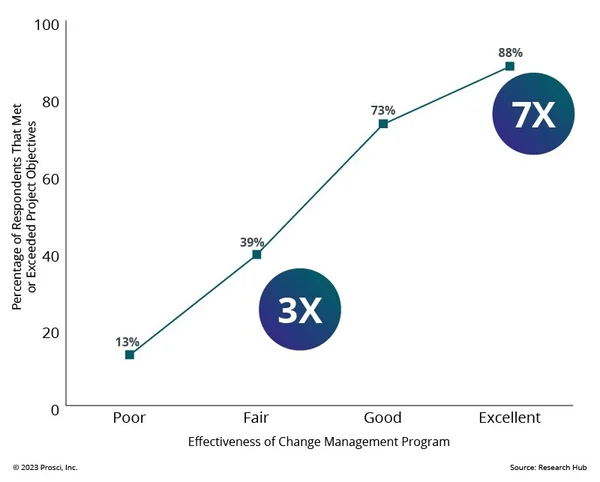
Prosci’s global benchmarking data shows that projects with excellent change management are seven times more likely to meet or exceed objectives than those with poor change management. Yet many organizations still treat it as an add-on, something to address after the system is built.
How Change Management Effectiveness Correlates with Success
In reality, change management should begin before implementation. That is when you define success, identify impacted groups, and start building readiness. It is also when experienced advisors can help you see what is coming and prepare for it.
During presales conversations, I often find that leaders are focused on infrastructure risks, such as unsupported systems or service outages, but they have not considered the broader value the new platform can bring. Experts bring a completely different perspective. They expand the conversation beyond replacement and into opportunity by illuminating hidden factors.
For example:
- Framing ERP as a business transformation, not just a tech upgrade
- Providing real-world case studies and peer connections in other organizations
- Offering ongoing leadership coaching and team guidance through the change journey
Avoid the common pitfalls
ERP failure rates are sobering. According to a 2022 article by Harvard Business Review, large-scale digital transformations have failed at an average rate of 87.5%.
The 2023 Best Practices in Change Management report from Prosci found that 55 percent of ERP projects exceeded budget, and 72 percent took longer than expected. Even more concerning, 29 percent of organizations reported outright failure—meaning the project was stopped, abandoned, or did not deliver measurable benefits.
And a 2024 BCG report revealed that 70% of large-scale tech programs completely or partially failed to deliver on time, and within scope and budget.
These failures rarely stem from technology alone. Instead, they are caused by misalignment, poor planning, and underestimating the people side of change. Human factors such as unclear leadership, weak sponsorship, resistance, and skills gaps are top culprits.
It is not unusual for organizations to treat ERP as a purely technical deployment, only to discover that no one is using the system as intended. In one such case, a European energy provider I worked with had a technically flawless rollout, but the system was ignored because the change had not been embedded culturally. After five attempts, they achieved the adoption they needed but their success came at a high cost. In addition to rework, they needed to overcome the misconception and their own belief that they were not good at change. That kind of experience is avoidable—but only if you plan for it.
No matter how good your project management is, if people don’t change the way they work with your systems and processes, and within your culture, you won’t achieve the business outcomes you intended.
When you bring in expertise that understands both the technical and human dimensions of ERP, you are better equipped to uncover hidden complexity, align stakeholders, and design an implementation that fits your culture and capacity.

Understand that agility is an asset
ERP delivery timelines are changing. What used to take 18 to 30 months can now be delivered in half the time, especially when organizations adopt agile methodologies and cloud platforms.
African organizations are well-positioned to take advantage of this shift. With fewer legacy systems and a strong appetite for innovation, many are moving faster than their global counterparts. I have seen organizations reach advanced levels of change maturity in under a year—a journey that typically takes three.
That kind of agility is not just impressive. It is essential. The pace of change is increasing, and organizations that can adapt quickly will be the ones that thrive.
In fact, the shift toward agile delivery models has been one of the most significant changes taking place in ERP initiatives over the past decade. The traditional waterfall approach is being replaced. Instead of designing, building, and deploying separately and with long timelines, it is necessary now to use iterative cycles that allow for faster feedback and adjustment. This approach requires a different mindset and is another reason why change management should be embedded from the beginning.
Pay attention to culture and context
ERP is not one-size-fits-all. Even within the same organization, different sites and teams may operate in vastly different ways. Such diversity is not a problem, but it does require attention.
We have all been taught that a change has a current state, transition state, and future state. But there is rarely a single “current state.” Each location may have its own processes, tools, and assumptions. This can be true across different global markets, business units, and even departments within the same location.
When I worked with a global manufacturing business and supported a global ERP rollout, we quickly realized that many parts of the business, and similar teams in different locations, had their own way of working. While the reporting and newly designed processes could be standardized, the engagement needed to be localized to help people understand and embrace the change. This is true in Africa too. Understanding your cultural context, and designing for it, is critical to success.
If you treat the organization as uniform, you risk missing and devaluing the very differences that will shape and support adoption. That is why we take time to understand the entire landscape before designing the change journey.

Change Starts with People
Technology does not transform organizations. The people who use it do.
From the moment ERP is mentioned, change begins. That is when expectations form, resistance builds, and momentum can shift. If you wait until go-live to address those dynamics, you are already behind.
The most successful ERP projects I have led alongside clients are the ones where leaders invest in change readiness early. They build desire for change, equip managers, and create space for people to adapt. And they do it with support—not just from vendors, but from advisors who understand the journey.
In Africa, there is a strong appetite for learning and growth. Leaders are actively seeking ways to improve how their organizations operate. That mindset is a strength. It means you do not have to spend time convincing people that change is necessary. Instead, you can focus on helping them shape it.
Plan for Success
If you are a leader, manager or other decision maker considering ERP, keeping these pointers in mind can keep your digital transformation on the right track:
- Begin with a clear vision of success, focused on business outcomes
- Engage change management early, before implementation begins
- Understand your current state, including cultural and operational differences
- Design for agility, and be ready to adapt
- Invest in people, because they are the ones who will make it work
ERP is a significant undertaking. With the right preparation, it becomes a powerful lever for growth. Whether you are modernizing operations, expanding into new markets, or building a more resilient organization, the opportunity is real—and it is worth getting right.